Roshan's lab at NVP 2025

Our lab is excited to attend the 2025 Dutch Brain & Cognition Winter Conference in Egmond aan Zee from December 17 to 19. We’ll be participating with presentations and during poster sessions. Come and find us to get to know us and discuss our latest findings!

This year's labmembers & projects:

Helena Olraun: Defining the cortico-striatal mechanisms of selective working memory gating

We investigated how the brain selectively controls what enters and leaves working memory by combining a novel input/output gating task with high-field fMRI. Across studies, we show that working memory gating engages cortico-striatal circuits and produces neural gain in relevant sensory cortex. Crucially, ultra-high-field data reveal preliminary evidence for layer-specific cortical connectivity, suggesting distinct feedforward and feedback mechanisms for input and output gating.

Natalie Nielsen: Distraction-related reduction of ruminative thoughts

Worrying, overthinking, replaying things that happened in the past without finding a solution is called rumination. Rumination is common in anxiety and depression and linked to memory problems. Past research shows that when we recall a memory, it can change. In this study, we tested whether distraction affects negative thoughts more than neutral ones. Participants linked personal thoughts to pictures, after which they focused on one, and were sometimes distracted. After 24 hours, they rated their thoughts again. Negative thoughts became less negative over time, even without such effects during the task. This suggests that the task itself might have helped weaken ruminative thinking 24 hours later.

Egbert Hartstra: Dissociable controllability and value signals in medial frontal cortex and striatum during reinforcement learning

During this talk, I will present the results of a recent fMRI study investigating whether environmental controllability provides the brain with an important source of information for deciding to rely on automatic but inflexible behaviour or on goal-directed but resource-intensive behaviour. Results show that when participants had control over their environment, they relied less on automatic behaviour. Furthermore, fMRI analyses revealed that the medial prefrontal cortex tracks environmental controllability, while action- and state-value signals were observed in dorsal-lateral and ventral-medial striatum. This suggests that the brain tracks both controllability and action-value computations in different brain regions when deciding how to act.

Marwan Engels: Establishing the reliability of a task measuring the impact of controllability on motivation

Motivated behavior depends not only on reward anticipation, but also on beliefs about how much control we have over our environment. We developed a motivational go/no-go task to disentangle controllability from reward value, and, in this study, assess its reliability across sessions. Model-agnostic Bayesian analyses of reliability demonstrate moderate reliability for action-outcome learning. Our next step is employing more complex computational models that capture dissociable trial-wise fluctuations in controllability and reward anticipation to increase test-retest reliability. These findings pave the way for our upcoming transcranial ultrasonic stimulation study where we will target the striatum and pregenual ACC to causally test their causal mechanistic roles in motivation.

Upasana Shah: Disentangling effects of serotonin in Motivation as a function of controllability and reward anticipation

Serotonin has been implicated in motivated behaviour and learned helplessness, with greater release when outcomes are uncontrollable. However, the computational mechanisms by which serotonin shapes motivation remain unclear, as prior studies confound controllability and value. In this poster, I will present ongoing work on a task that dissociates controllability from value while using an SSRI manipulation. Preliminary unblinded analyses suggest higher reward anticipation in low-control/high-value contexts, higher controllability inference in high-control/low-value contexts, and an increased influence of valence on Pavlovian bias as a function of controllability. In the future, we expect to clarify the role of serotonin in decision making by examining how serotonin modulates value, controllability, and motivational biases.

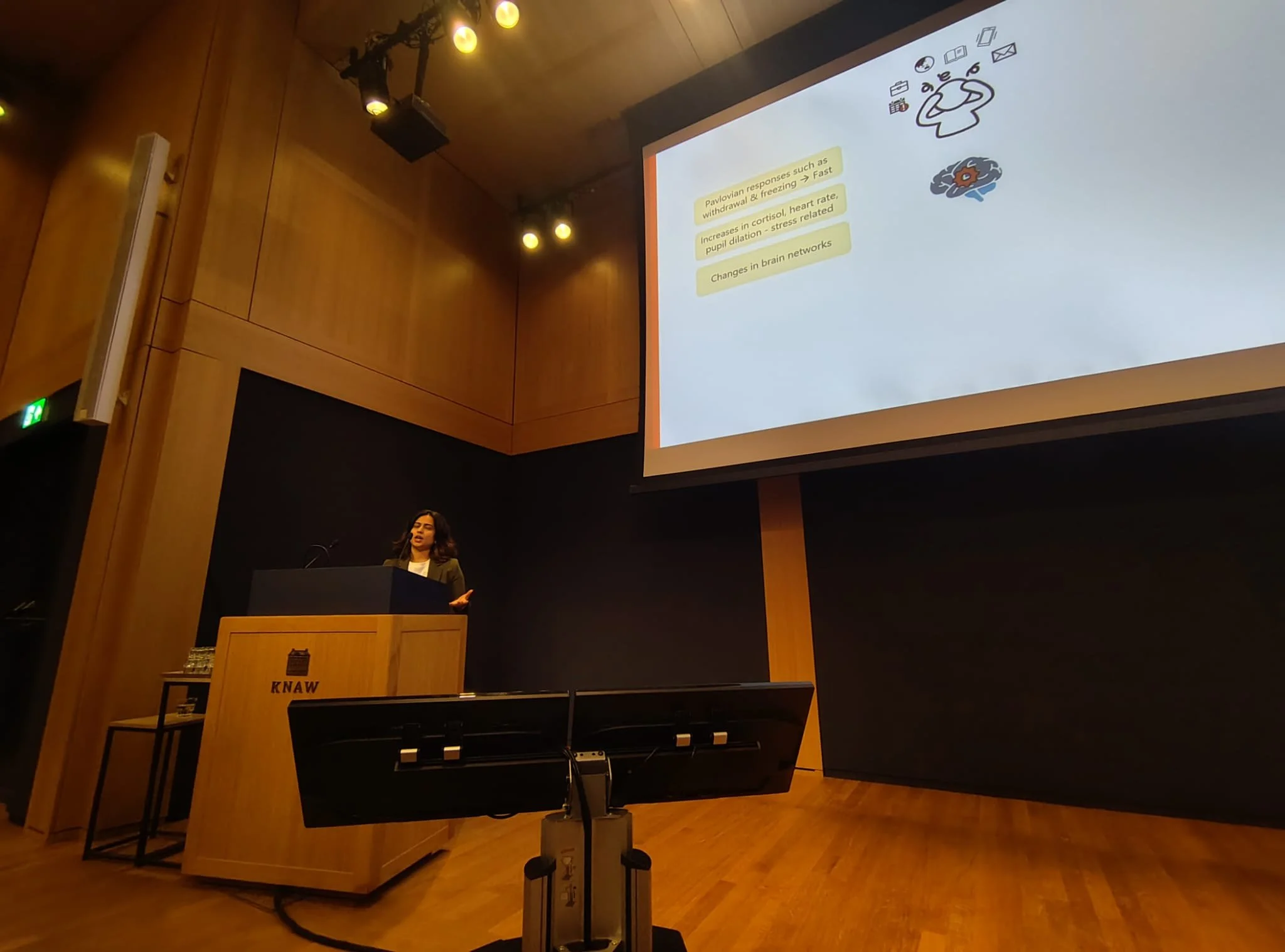
Yanfang Xia: Anticipatory pupil dilation is enhanced by threat and suppressed by control beliefs

We face stressors every day, yet we are not constantly stressed. What are the cognitive mechanisms regulating the perception and response to stressors?

In this talk, I will share evidence that our physiological stress responses are shaped by control beliefs in the environment. Building on work on learned helplessness, we used a shock-avoidance learning task manipulating controllability and stress-relief anticipation. We show that while threat enhances anticipatory pupil dilation, control beliefs suppress it.

Interested in the remarkable power of our minds regulating bodily stress responses? Join the session “Cognitive Control & Executive Functioning” at 10:30 on 19 December 2025 😊


NEW DONDERS WONDERS BLOG

Dopamine: the chemical gatekeeper of your working memory

In a previous blog, we discussed the concept of working memory gating: the brain’s mechanism for deciding which information enters or exits our mental workspace. As described there, a deep part of our brain, called the basal ganglia, and the front part, called the prefrontal cortex (PFC), work together to open and close these gates, deciding which information is useful for guiding our behavior. But how exactly does this work?

Studies show that dopamine, a chemical messenger in the brain, helps to open and close the gates to working memory. 

Click here to read more.

Post by Helena Olraun at Donders Wonders

Image created with Adobe firefly

Layer by Layer: How laminar fMRI captures the brain in action

Functional MRI (fMRI) has long been a core method to study brain function. Conventional fMRI, however, captures only a “zoomed out picture.” A more high-resolution version, laminar fMRI, lets scientists closely examine the different layers of the brain. But how does this work?

Click here to read more.

Post by Helena Olraun at Donders Wonders

Image created by Leon JL on Unsplash

What can you see with your mind’s eye?

Think of an apple. What do you “see” in your mind’s “eye”? A vivid image of a crisp red apple, sitting in your palm? Or maybe it’s more like an emoji of an apple. Perhaps you can only imagine the rough shape? Or do you think of the word “apple” with no mental pictures at all? What you just experienced can reveal how much of a visual thinker you are.

Click here to read more.

Post by Helena Olraun at Donders Wonders

Image created by Tara Winstead on pexel.com 

Interview: Roshan Cools on the value of international experience for a career in science

Professor of Cognitive Neuropsychiatry Roshan Cools is one of the members of the Social Sciences advisory committee for the newly launched Ammodo Science Fellowship, a EUR 50,000 to EUR 200,000 postdoctoral fellowship for research abroad. We asked her for the when writing a research application and the value of international exchange. Before taking a permanent position at the Radboudumc in Nijmegen in 2007, Cools spent several years doing research abroad including a two-year postdoc in the US city of Berkeley. “It was the most fantastic time of my life,” she says.


Click here to read the full interview.
Picture from: https://www.ammodo.org/en/reflecties/roshan-cools/

Speaking (with) your mind: How we can use brain-computer interfaces to communicate without speech

For social creatures such as humans, communication is key. However, certain conditions can make verbal communication difficult. Recent studies have been able to use Brain-Computer Interfaces to translate brain signals to speech so they can help speech-impaired patients communicate without needing to speak.

Click here to read more.

Post by Helena Olraun at Donders Wonders
Featured image by sudatimages on shutterstock

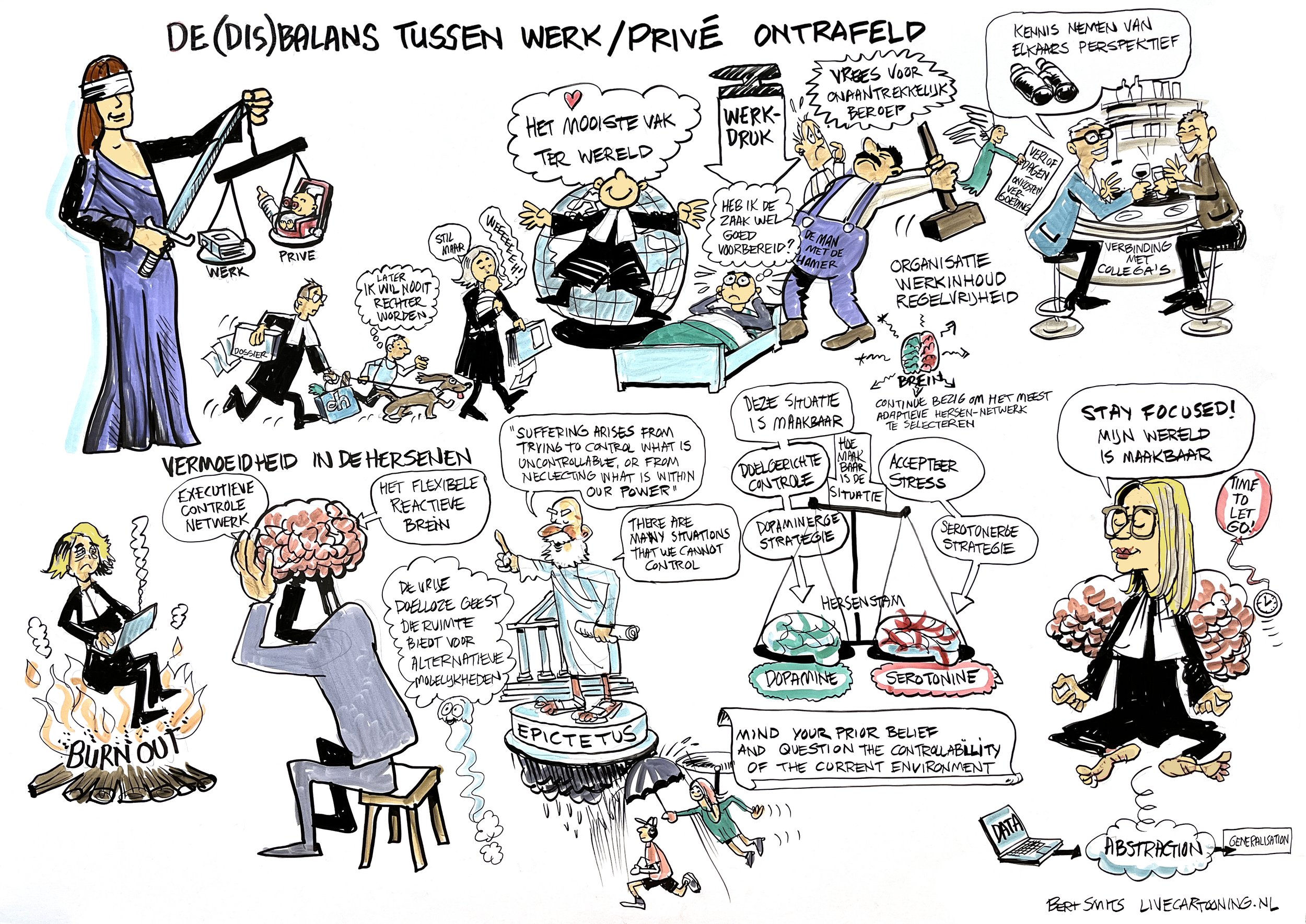
Roshan Cools bij Radboud Reflects over 'Telefoons de school uit: betutteling of broodnodig?'

“Aankondiging - De telefoon de klas uit. Het is duidelijk dat dit beter is voor de concentratie en het leervermogen. Maar gaat dat wel ver genoeg? Moet niet de hele school een telefoonvrije zone worden? Juist in de pauzes en op de gangen bepalen telefoons hoe kinderen met elkaar omgaan. Moeten kinderen op school vrij van sociale media hun sociale vaardigheden kunnen opdoen, of horen telefoons er tegenwoordig nu eenmaal bij? Kom luisteren naar neurowetenschapper Roshan Cools en ontwikkelingspsycholoog Loes Pouwels en ontdek welke effecten telefoons op scholen hebben op het leervermogen en de sociale ontwikkeling van kinderen.”

Klik hier om het volledige rapport te lezen.

Living on autopilot: the role of dopamine

Do you ever Google a healthful diet for your cat but end up scrolling through pet meme videos? You unintentionally do this because your attention is distracted by the pet videos that make you happy. Humans are attracted to rewarding cues in the environment, like memes, deviating from the actions we were actually planning to do. This is a hardwired bias that shapes our behavior automatically. Our recent study shows that the amount of the brain chemical dopamine might explain these mindless actions.

Click here to read more.

Post by Ping Chen at Donders Wonders

Why put in the effort if there is nothing to learn?

Cognitive effort avoidance is an intuitive concept, especially when faced with the demands of academic programs. However, as all academics would appreciate, many of us continue to persist in our specialized fields despite this challenge. This paradox led to the research question whether all effort is created equal.

Click here to read more.

Post by Ceyda Sayalı for Radboudumc Research Newsletter